Answer
Do businesses pay taxes on crypto?
Quick answer
Yes. The IRS treats crypto as property: payments a business receives are ordinary revenue valued in dollars at receipt, and later selling, spending, or converting crypto triggers gain or loss against its cost basis. Simply buying and holding isn't taxable — disposal is. Good dollar-valued records make all of it routine.
Updated October 2026. Evergreen page — refreshed in place as facts change.
- IRS treatment
- Property
- Since Notice 2014-21
- Buying with dollars
- Not taxable
- Tax attaches at disposal
- Crypto received
- Income
- At its dollar value when received
- C corporation rate
- 21%
- Federal, on income and gains
- Crypto-to-crypto
- Taxable
- Every swap is a disposal
- Broker forms
- 1099-DA
- Proceeds from 2025; basis from 2026
- Contractor 1099
- $2,000
- 1099-NEC threshold for 2026 payments
- Staking rewards
- Income
- When received (Rev. Rul. 2023-14)
Do businesses pay taxes on crypto? Yes — at two moments, measured with one habit. Everything here is general information about how US federal rules commonly work, not tax advice; a CPA who knows digital assets is worth every dollar. That said, the framework is simpler than its reputation: income when the business receives crypto, gain or loss when it disposes of crypto, and dollar-valued records that make both computable.
This page walks through every common event and whether it's taxable, two worked examples, how the answer differs for a C corporation and a pass-through, what happens when the business pays vendors or contractors in crypto, what brokers now report to the IRS, the records to keep, and the corporate minimum tax point that matters to the largest holders.
Payment methods on this page
.svg)
.svg)
.svg)
.svg)
When does a business owe tax on crypto?
The IRS has treated virtual currency as property since Notice 2014-21, so the rules for property apply: acquiring it with dollars sets a cost basis, receiving it as payment is income, and getting rid of it — by selling, swapping or spending — realizes gain or loss. Most of the confusion comes from events that feel like non-events but aren't, and vice versa.
| Event | Taxable? | What's measured |
|---|---|---|
| Buy crypto with dollars | No | Cost basis: the price paid, plus fees |
| Receive crypto as payment | Yes — ordinary income | Dollar value at receipt, which also becomes basis |
| Sell crypto for dollars | Yes — gain or loss | Proceeds minus basis |
| Swap one crypto for another | Yes — gain or loss | Value of what you received minus basis given up |
| Pay a vendor or contractor in crypto | Yes — disposal and an expense | Gain or loss on the coins; a deductible payment at value |
| Move crypto between the company's own wallets | No | Nothing, but keep the trail |
| Receive staking rewards | Yes — ordinary income | Dollar value when you gain control of them |
| Hold through price changes | No tax | Nothing for tax; book accounting may differ |
Taxable moment one: receiving crypto as revenue
When a customer pays your business in crypto, you've earned ordinary revenue equal to the payment's dollar value at receipt — exactly as if they'd paid cash. That value also becomes your cost basis in the asset you now hold. A $5,000 invoice paid in USDC is $5,000 of revenue and $5,000 of basis.
This is why stablecoin invoicing is accounting-friendly: value at receipt equals face value, and later conversion produces little or no additional gain. An invoice paid in bitcoin works the same way at receipt, but the coins then carry price exposure until the business disposes of them.
Taxable moment two: disposing of crypto
Selling for dollars, converting one asset to another, or spending crypto on anything are all disposals: you recognize gain or loss equal to value at disposal minus basis. Note the middle one — swapping BTC for USDC is a taxable event even though no dollars appeared; crypto-to-crypto trades don't defer anything.
Buying crypto with dollars and holding it, by contrast, triggers nothing. Unrealized price movement isn't taxed for most operating businesses under current federal rules. The worked example below follows one purchase through to sale, with round numbers for illustration.
| Step | Dollar amount | Tax effect |
|---|---|---|
| Buys 1 BTC, paying $60,000 plus a $300 fee | $60,300 | No tax; basis is $60,300 |
| Price rises to $75,000 at year-end; still held | — | No tax for the year |
| Sells 1 BTC for $85,000, net of a $400 fee | $84,600 proceeds | Gain of $24,300 |
| Held more than a year before the sale | — | Long-term for a pass-through's owners; no special rate for a C corporation |
How is the gain taxed — C corporation or pass-through?
A C corporation pays federal tax at a flat 21% on its taxable income, capital gains included — there's no lower long-term rate at the corporate level. Its capital losses can only offset capital gains, not operating income; unused losses carry back three years and forward five.
In a pass-through — a disregarded single-member LLC, a partnership or an S corporation — gains and losses flow to the owners' own returns. Owners who are individuals get the long-term capital gains rates for assets held more than a year, and can use capital losses against gains plus up to $3,000 a year of other income. Which applies to you depends on how the entity is classified for tax, not what it's called.
What happens when a business pays vendors or contractors in crypto?
Two things happen at once. The payment is an expense valued in dollars at the time it's made — deductible if the underlying cost is. And handing over the coins is a disposal, so the business recognizes gain or loss on them against their basis. Paying a $10,000 invoice with bitcoin bought for $6,000 is a $10,000 expense and a $4,000 gain. Paying it with USDC bought at $1 produces essentially no gain, which is why most companies run crypto payouts in stablecoins.
Information reporting doesn't change because the rail did. US contractors paid in crypto get a Form 1099-NEC at the payment's dollar value; for payments made in 2026 the reporting threshold is $2,000, up from $600 for 2025 payments. Employees are different: wages paid in crypto are still wages, valued in dollars, with withholding and payroll taxes, which is why most employers pay W-2 wages in dollars and keep crypto for contractors or supplemental compensation.
Paying a $10,000 invoice in crypto: the tax events
- 1
Invoice
A US contractor bills the business $10,000.
$10,000 - 2
Pay in BTC
Coins bought for $6,000 are sent, worth $10,000 now.
Disposal - 3
Expense
The business records a $10,000 payment for services.
Deductible - 4
Gain
$10,000 value minus $6,000 basis is recognized.
$4,000 gain - 5
Report
1099-NEC at $10,000 if the contractor is over $2,000.
2026 rule
What will brokers report to the IRS?
Custodial platforms that act as brokers now file Form 1099-DA. For sales in 2025, brokers report gross proceeds, with cost basis optional; for sales from January 1, 2026, they must also report basis for 'covered' assets — generally those acquired on or after that date and held in the same account. Non-custodial wallets and decentralized platforms don't file them, so coins that pass through those won't appear on any 1099-DA.
Treat the forms as a cross-check, not your records. A 1099-DA can't see basis for coins bought elsewhere, transferred in from a wallet, or received as payment, and since 2025 basis has to be tracked wallet by wallet and account by account rather than pooled across everything the company holds. Your books, not a broker's form, are the source of truth.
What the records need to capture
Every crypto event needs the same core fields: the date and time, the asset and amount, the dollar value at the time, what kind of event it was (receipt, purchase, disposal, transfer), and which wallet or account it sat in. From those, your preparer computes everything. Without them, year-end becomes forensic reconstruction across wallets and block explorers.
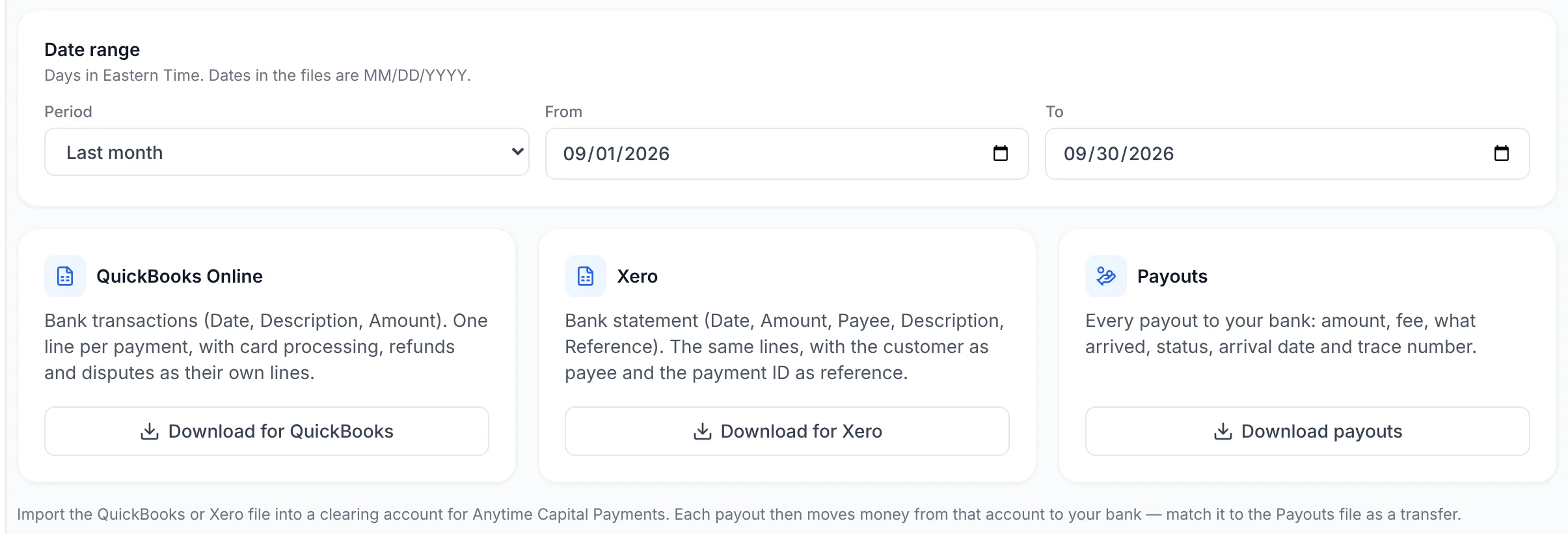
On Anytime Capital, Crypto → History lists every purchase and sale made for the business with its dollar amount, method and status, and the Reports screen downloads files formatted for QuickBooks Online and Xero, plus a payouts file. Invite your CPA with the Accountant role: read-only access to payments and the balance, with statements, reports, accounting exports and tax forms.
- Date and time, asset, quantity and dollar value of every event
- Event type: receipt, purchase, sale, swap, payment out, or own-wallet transfer
- Which wallet or account held the coins — basis is tracked per wallet since 2025
- Fees paid on each purchase and sale
- The invoice or counterparty behind each receipt and payment
What about the corporate minimum tax and state rules?
The largest companies have one more question. The corporate alternative minimum tax applies to groups whose average annual adjusted financial statement income exceeds $1 billion, and fair-value accounting puts unrealized crypto gains into financial statement income. On September 30, 2025 the IRS issued interim guidance (Notices 2025-46 and 2025-49) that lets companies disregard unrealized gains and losses on digital assets held at fair value when computing that income. For everyone else, tax still follows realization.
A few other areas deserve professional attention rather than a page's summary: receiving tokens with no liquid market (valuation questions), businesses that hold crypto as inventory rather than an investment (ordinary rather than capital treatment), and state-level rules layered on top of federal ones. None are blockers; all are 'ask your CPA' items.
What should a business bring the accountant at year-end?
A complete, dollar-valued export covering every wallet and account, reconciled to the bank statements — so that every dollar that entered or left for crypto has a matching record on the crypto side:
- Transaction exports from every platform and wallet, with dollar values
- Opening and closing holdings by asset and by wallet
- Basis and acquisition date for each lot sold during the year
- Transfers between the company's own wallets, so none looks like a sale
- Crypto received as revenue, matched to invoices
- Crypto paid out, with recipients and 1099 details for US contractors
- Any 1099-DA forms received, for cross-checking
On Anytime Capital
FedNow, RTP, Fedwire and ACH in one business account
Pick the rail per payment instead of per bank: instant when it has to land now, a wire when the counterparty insists, ACH when it can wait, and local rails or stablecoins when it crosses a border. Sign up online in minutes.
- RTP & FedNowSeconds, any day
- WireSame day
- ACH to vendorsSame day or next day
- 71+ countriesMinutes to same day
- USDC & USDTMinutes, including weekends
Business account
Send and receive on every US rail
US account and routing numbers in your business's own name. Get paid by FedNow, RTP, wire or ACH, and pay the same ways, with every movement in one ledger.
Enterprise treasury
Operating accounts, approvals, API
Operating accounts and sub-accounts, approval rules and an audit trail, plus an API and signed webhooks for moving money from your own systems.
Personal
A cash account with a debit card
A cash account and card with early direct deposit and crypto built in, opened online in minutes, with no minimum balance.
Frequently Asked Questions
Is just holding crypto taxable for a business?
Holding itself isn't a taxable event under current federal rules — tax attaches at receipt (as revenue) and disposal (as gain or loss). Financial-statement accounting is a separate question from tax.
We accept USDC and convert same-day. What's the tax picture?
Clean: revenue at the dollar value received, and a same-day conversion at essentially the same value produces negligible additional gain. This simplicity is a major reason businesses standardize on stablecoin acceptance.
Do exchanges report our activity to the IRS?
Custodial brokers file Form 1099-DA: gross proceeds for 2025 sales, and basis for covered assets sold from 2026. Assume platforms report, and keep your own records matching — your books, not the platform's, are the source of truth.
What should we bring the accountant at year-end?
A complete transaction export with dollar values: receipts, purchases, disposals, and transfers between your own wallets (which aren't taxable but must be traceable so nothing looks like a disposal).
Can a business deduct crypto losses?
Realized losses count against gains. A C corporation can use capital losses only against capital gains, carrying unused losses back three years and forward five; pass-through owners apply them on their own returns. General information, not tax advice.
Do we charge sales tax on sales paid in crypto?
Yes, wherever the sale itself is taxable. Crypto is the payment method, not a tax exemption — the sales tax due is based on the sale's dollar price, as with card or cash.
Is converting a stablecoin to dollars taxable?
Technically it's a disposal, so any difference from basis is gain or loss. With a stablecoin bought or received at $1 and sold near $1, the result is usually negligible — but it still belongs in the records.
Keep reading
Important Disclosures
- Cryptocurrencies and stablecoins are not FDIC-insured deposits, are not bank guaranteed, and can involve risk, including possible loss of value.
- Cryptocurrency transactions are irreversible once confirmed. Verify all details before sending.
- Additional identity verification may be required depending on transaction type and amount.
- Third-party fees, timings, and product details cited on this page are industry-typical figures as of the date shown and may have changed. Verify current details with the relevant institution.
- Anytime Capital is a licensed money services business. Information on this page is educational and is not financial, legal, or tax advice.
- Anytime Capital is a fintech company, not a bank. Banking services are provided by our licensed banking partners. Stablecoins and other digital assets are not bank deposits, are not FDIC-insured and may lose value.