Answer
How long does a wire transfer take?
Quick answer
Most domestic US wire transfers arrive the same business day — often within a few hours — when sent before the bank's cutoff time, commonly mid-afternoon Eastern. International wires usually take 1–5 business days. Wires do not move on weekends or US federal holidays, so timing around cutoffs matters.
Updated October 2026. Evergreen page — refreshed in place as facts change.
- Domestic wire
- Same day
- Sent before your bank's cutoff; often within hours
- International
- 1–5 days
- Business days, over SWIFT
- Fedwire hours
- 9p–7p ET
- Opens the evening before each business day
- Customer cutoff
- 6:45 p.m.
- Fedwire's own deadline, ET; banks set earlier ones
- Weekends
- Closed
- Sunday sessions planned for 2028–29
- Fedwire volume
- $4.59T/day
- Average daily value, 2025 (Federal Reserve)
- Instant rails
- Seconds
- FedNow and RTP, 24/7/365
- Instant limit
- $10M
- FedNow and RTP network maximum per payment
How long a wire transfer takes depends far less on the network than on the clock. Fedwire, the Federal Reserve system that carries almost every domestic US wire, settles each payment in seconds. What decides whether your money lands this afternoon, tomorrow morning or next Tuesday is when you send it, how long your bank's review takes, and whether the receiving bank credits it promptly. This page breaks each of those down, with the cutoffs, the weekend and holiday rules, the international timelines, and the instant rails that now beat a wire when the deadline is tonight.
Payment methods on this page
.svg)
Wire arrival calculator
When will my wire arrive?
Arrives today, Thursday, October 29
Before your bank's 5:00 p.m. cutoff: it leaves today and usually lands within a few hours.
- Thu29Arrives
- Fri30Open
- Sat31Closed
- Sun1Closed
- Mon2Open
- Tue3Open
- Wed4Open
Domestic wires settle on Fedwire the day they're released; the receiving bank credits them that day, usually within hours.
Can't wait? On Anytime Capital, FedNow and RTP payments settle in seconds, 24/7/365, weekends and holidays included.
Open a business accountEstimates for planning, in Eastern time. Banks set their own cutoffs and may hold a wire for review; Federal Reserve holidays follow the Reserve Banks' published schedule.
How long does a domestic wire transfer take?
A domestic wire submitted before your bank's cutoff typically reaches the recipient's account the same business day, and frequently within one to four hours. The Fedwire Funds Service settles each transfer individually and immediately, in central bank money, the moment the sending bank releases it. Most of the elapsed time you experience sits on either side of that moment: your bank's verification and release queue before it, and the receiving bank's crediting process after it.
Submitted after the cutoff, the wire is processed the next business day — usually in the morning, because banks release their overnight queue early. That single rule explains most 'same-day' wires that land tomorrow. A wire between two accounts at the same bank (a book transfer) never touches Fedwire at all and often posts in minutes.
A domestic wire, start to finish
- 1
You send
Name, account and routing number, amount, before the cutoff.
Before ~3–5 p.m. ET - 2
Your bank reviews
Verification, sanctions screening and fraud checks; a callback on large or first-time wires.
Minutes to hours - 3
Fedwire settles
Bank-to-bank in central bank money, individually and irrevocably.
Seconds - 4
Their bank credits
The receiving bank matches the name and account and posts it.
Minutes to hours - 5
Money is available
Wired funds are final: no check-style hold.
Same business day
Wire transfer timelines at a glance
The same wire can take two hours or four days depending on when and where it goes. These are the timelines our own payments team plans around, by scenario:
| Scenario | Typical arrival | Why |
|---|---|---|
| Domestic, sent in the morning | Same business day, often 1–4 hours | Plenty of buffer before the cutoff for review and release |
| Domestic, sent near the cutoff | Same day or next morning | A callback or review can push it past the cutoff |
| Domestic, sent after the cutoff | Next business day | Queued and released when the bank's wire desk reopens |
| Sent Friday after the cutoff | Monday (Tuesday after a Monday holiday) | Fedwire is closed on weekends and federal holidays |
| Same bank, account to account | Minutes | A book transfer never leaves the bank |
| International, major corridor (EUR, GBP, CAD) | 1–2 business days | One correspondent hop, well-banked destinations |
| International, less common corridor | 2–5 business days | Several correspondents, time zones, currency controls |
| Incoming international wire | 1–5 business days | Set by the sender's bank and its correspondents |
What time do wires stop processing each day?
Fedwire's business day runs from 9:00 p.m. Eastern on the evening before to 7:00 p.m. Eastern, and the Federal Reserve's deadline for wires sent on behalf of a bank's customers is 6:45 p.m. ET. Your bank's own cutoff is earlier — commonly between 3:00 and 5:00 p.m. ET for consumer and online wires — because it needs time after you submit to verify, screen and release the payment before the network closes. International wire cutoffs are usually earlier still, often around midday Eastern.
If a transfer is time-critical, submit it in the morning. That leaves room for a verification callback, a compliance question or a corrected detail without losing the day.
A wire business day, in Eastern time
Fedwire
Business days
Your bank
Typical wire desk
Best time to send
Room for review
FedNow & RTP
Every day
Do wire transfers go through on weekends or holidays?
No. Fedwire operates on business days and observes the eleven US federal holidays the Federal Reserve closes for, so a wire submitted Friday evening is processed Monday — or Tuesday if Monday is a holiday. Some banks let you schedule a wire over the weekend, but it queues until the next business day either way.
That is starting to change. In October 2025 the Federal Reserve approved expanding Fedwire to 22 hours a day, six days a week — adding Sunday and weekday holidays — with implementation expected in 2028 or 2029. Until then, the 24/7 options are FedNow and RTP between participating banks, and stablecoin transfers between crypto-ready parties.
- Federal Reserve holidays (no wires): New Year's Day, Martin Luther King Jr. Day, Washington's Birthday, Memorial Day, Juneteenth, Independence Day, Labor Day, Columbus Day, Veterans Day, Thanksgiving Day and Christmas Day.
- When a holiday falls on a Saturday, banks generally stay open the Friday before; when it falls on a Sunday, the Fed closes the following Monday.
- Plan wires before long weekends early in the week — the day before a holiday is one of the busiest of the year for wire desks.
When each rail moves money, across a week
Fedwire
Wires
ACH
Batched windows
FedNow & RTP
Instant
USDC & USDT
Stablecoins
How long does an international wire transfer take?
Plan on 1–5 business days for international wires in 2026. The payment is coordinated over SWIFT and may pass through one or more correspondent banks, each with its own processing schedule, sanctions screening and time zone. Currency conversion and destination-country controls can add time; transfers to well-banked corridors often arrive in 1–2 business days, while less common corridors take longer.
SWIFT gpi tracking, which most major banks support, lets the sending bank see exactly where a payment is — ask for the UETR reference if you need to trace one. And for many countries there is now a faster route than SWIFT entirely: paying the recipient over their own country's instant rail, such as SEPA Instant in the euro area, Faster Payments in the UK, PIX in Brazil, SPEI in Mexico or UPI in India, which typically arrives in seconds to minutes.
| Destination | Typical SWIFT wire | Local instant rail |
|---|---|---|
| Euro area | 1–2 business days | SEPA Instant: seconds, 24/7 |
| United Kingdom | 1–2 business days | Faster Payments: seconds, 24/7 |
| Canada | 1–2 business days | Bank transfer: same day to next day |
| Mexico | 1–3 business days | SPEI: seconds, 24/7 |
| Brazil | 1–3 business days | PIX: seconds, 24/7 |
| India | 1–3 business days | UPI and IMPS: seconds |
| Singapore | 1–2 business days | PayNow and FAST: seconds, 24/7 |
| Frontier markets | 2–5 business days | Mobile money: minutes, where available |
Why is my wire taking longer than expected?
The usual suspects, roughly in order of frequency: it missed the cutoff; a detail was wrong or incomplete (name mismatches matter — banks screen them); it was held for compliance review; or, on international transfers, an intermediary bank is slow. Compliance holds are routine, not accusatory: banks and money services businesses are required under the Bank Secrecy Act to screen transfers, and a reviewer may need to confirm the purpose of a payment before releasing it.
We run those reviews ourselves at Anytime Capital, so we can say this from the reviewing side: a prompt, plain answer to a verification question is what releases a held transfer fastest. The checklist we would run on a late wire:
- Missed cutoff — check the submission timestamp against your bank's posted cutoff; anything later is tomorrow's wire.
- Name mismatch — the beneficiary name must match the receiving account closely; 'J. Smith LLC' against 'Smith Holdings' can stop a wire at either bank.
- Wrong routing number — some banks publish a separate routing number for wires; an ACH routing number on a wire can bounce it.
- Compliance or sanctions review — answer the bank's question the same day, in plain language, with an invoice or contract if you have one.
- First large wire — expect a verification callback on new payees and high amounts; pick up the phone.
- Receiving bank posting — the money can be at their bank but not yet in the account; the recipient should ask their bank to look up the wire by its IMAD.
- International chain — an intermediary bank may be holding it for screening or charging a fee; the UETR shows exactly which one.
How do you track a wire transfer?
Every domestic Fedwire payment carries an IMAD (Input Message Accountability Data) assigned when the sending bank submits it, and an OMAD once it is delivered; together they let either bank locate the payment definitively. International payments over SWIFT carry a UETR, a unique end-to-end reference that gpi-enabled banks can track hop by hop. Fedwire has used the ISO 20022 message standard since July 14, 2025, which also lets wires carry richer remittance detail — invoice numbers and references — end to end.
- Sender: ask your bank for the wire confirmation with the IMAD (domestic) or UETR (international), and send it to the recipient.
- Recipient: give the IMAD and amount to your bank; it can confirm whether the wire arrived and why it has not posted.
- Both: confirm the beneficiary name, account number and routing number match exactly what was sent — most 'lost' wires are mismatches.
- Still nothing after one business day (domestic) or five (international): ask the sending bank to open a trace or investigation.
How do you make a wire transfer arrive faster?
None of these cost anything, and together they remove most of the delays above:
- Send before noon Eastern, and never at the cutoff — the morning is when wire desks have the most room.
- Use the recipient's exact legal name as it appears on their account, and their bank's wire routing number.
- Put the invoice or reference number in the wire's reference field (the originator-to-beneficiary information) so the recipient can match it the moment it arrives.
- Save and verify recurring payees once, by phone on a number you already have, so later wires skip the first-time checks.
- Avoid Friday afternoons and the day before a federal holiday.
- For international payments, include any intermediary bank details the recipient gives you, or pay them over their local instant rail instead.
- If it has to land tonight or this weekend, do not use a wire at all: send by FedNow or RTP if both banks support it.
Which is fastest: a wire, FedNow, RTP or ACH?
A wire is no longer the fastest way to move dollars between US banks — it is the most universally accepted one. FedNow and RTP settle in seconds at any hour, and since 2025 both accept single payments up to $10 million at the network level. Where both banks are on an instant rail, it beats a wire on speed and availability; where a title company, escrow agent or counterparty insists on a wire, a morning wire is still the answer. The full comparison is in our Fedwire vs FedNow guide.
| Rail | Typical speed | Hours | Network max per payment | Reversible? |
|---|---|---|---|---|
| Fedwire (wire) | Same business day | 9 p.m.–7 p.m. ET, business days | No network cap; bank limits apply | No — final once settled |
| FedNow | Seconds | 24/7/365 | $10 million (bank default $100,000) | No — final |
| RTP | Seconds | 24/7/365 | $10 million | No — final |
| Same Day ACH | Hours | Business days, three windows | $1 million | Returnable in defined cases |
| Standard ACH | 1–3 business days | Business days | Bank limits | Returnable in defined cases |
| USDC / USDT | Minutes | 24/7/365 | None at the network level | No — final on chain |
Typical time to arrive, by rail
- FedNow / RTPSeconds
- StablecoinsMinutes
- Domestic wire1–4 hours
- Same Day ACHSame day
- Standard ACH1–3 days
- International wire1–5 days
How long does a wire take with Anytime Capital?
Timing follows the same rails described on this page, and processing is subject to compliance review. Anytime Capital business accounts send and receive by Fedwire, FedNow, RTP and ACH, and the dashboard shows the expected arrival for the rail you pick before you confirm: same business day for a domestic wire, usually within seconds for RTP and FedNow, one to three business days for standard ACH and one to five for an international SWIFT wire.
Incoming wires are credited when Fedwire delivers them. Each account's details include a reference to put in the wire's reference field, which is how an incoming payment is matched to your account and your invoice without anyone reading remittance text by hand. For anything time-critical, our processing times page shows how each payment method behaves on Anytime Capital, and the team can help before you send.
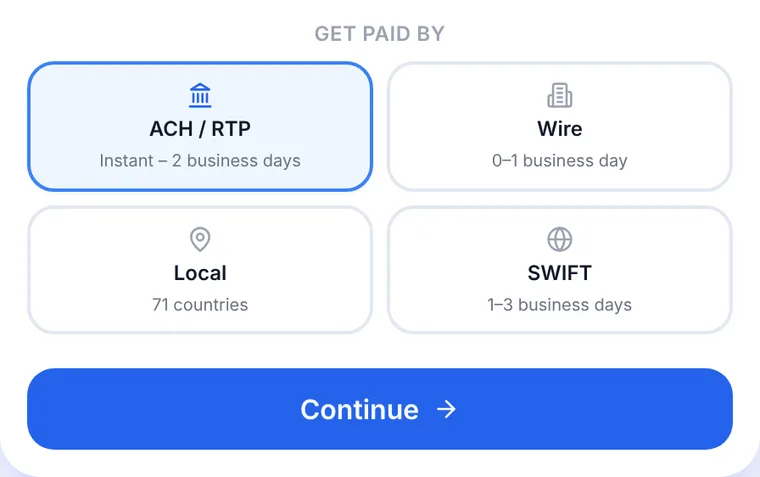
On Anytime Capital
FedNow, RTP, Fedwire and ACH in one business account
Pick the rail per payment instead of per bank: instant when it has to land now, a wire when the counterparty insists, ACH when it can wait, and local rails or stablecoins when it crosses a border. Sign up online in minutes.
- RTP & FedNowSeconds, any day
- WireSame day
- ACH to vendorsSame day or next day
- 71+ countriesMinutes to same day
- USDC & USDTMinutes, including weekends
Business account
Send and receive on every US rail
US account and routing numbers in your business's own name. Get paid by FedNow, RTP, wire or ACH, and pay the same ways, with every movement in one ledger.
Enterprise treasury
Operating accounts, approvals, API
Operating accounts and sub-accounts, approval rules and an audit trail, plus an API and signed webhooks for moving money from your own systems.
Personal
A cash account with a debit card
A cash account and card with early direct deposit and crypto built in, opened online in minutes, with no minimum balance.
Frequently Asked Questions
Can a wire transfer take 3 days?
Domestically that would be unusual — it typically means the wire missed a cutoff, was held for review, or had a detail that needed correcting. Internationally, three days is within the normal 1–5 business-day range, especially when correspondent banks or currency controls are involved.
What is the fastest way to wire money?
Submit early in the business day, well before the cutoff; double-check the recipient's name, account and wire routing number; and answer any verification call promptly. If both banks support instant payments, FedNow or RTP is faster than any wire: seconds, at any hour, up to $10 million at the network level.
Do wires post immediately once received?
Receiving banks generally credit wires the same business day they arrive, and wired funds are considered final — there is no hold period like a check. If a wire has arrived at the bank but not in the account, the delay is usually the bank's internal posting queue; the IMAD lets the bank find it.
What is the wire cutoff time at most banks?
Commonly between 3:00 and 5:00 p.m. Eastern for consumer and online domestic wires, and earlier — often around midday — for international wires. Fedwire's own deadline for customer wires is 6:45 p.m. ET, and the network closes at 7:00 p.m. ET.
How long does a wire take for a house closing?
Same business day if you send it in the morning, which is why title and escrow companies ask for wires a day or more before closing. Confirm the wiring instructions by phone on a number you already trust — closing wires are the most targeted payments for fraud.
How long does it take to receive an international wire?
Usually 1–5 business days, set mostly by the sender's bank and its correspondents. Ask the sender for the UETR reference: with it, your bank can see whether the payment is still in the correspondent chain or already arrived.
Why do banks have wire cutoff times at all?
Banks need time after your submission to verify, screen, and release payments before Fedwire stops accepting customer wires at 6:45 p.m. ET. Each bank sets its cutoff with enough buffer for that internal work, which is why cutoffs cluster in the mid-afternoon Eastern window.
Will wires ever work on weekends?
Partly. The Federal Reserve approved adding Sunday and weekday-holiday sessions to Fedwire — 22 hours a day, six days a week — with implementation expected in 2028 or 2029. Saturdays stay closed. Until then, FedNow and RTP are the 24/7 bank rails.
Keep reading
Important Disclosures
- Third-party fees, timings, and product details cited on this page are industry-typical figures as of the date shown and may have changed. Verify current details with the relevant institution.
- Additional identity verification may be required depending on transaction type and amount.
- Anytime Capital is a licensed money services business. Information on this page is educational and is not financial, legal, or tax advice.
- Anytime Capital is a fintech company, not a bank. Banking, card and payment services are provided by Anytime Capital's licensed partners, and each product's terms are shown at sign-up.
- Anytime Capital is a fintech company, not a bank. Banking services are provided by our licensed banking partners. Stablecoins and other digital assets are not bank deposits, are not FDIC-insured and may lose value.